Quick fix • Updated Mar 29, 2026 • 12 min read
Door handles & locks: renter-safe fixes for loose knobs and stiff locks
 By Michael Rivera · Updated Mar 29, 2026
A wobbly bedroom knob, a front door key that takes three tries to turn, a deadbolt that grinds against the strike plate every time you come home at night--door hardware problems are one of those things tenants live with for months because they seem too minor for a maintenance ticket. But they're also some of the fastest fixes in a rental, and most of them don't require anything beyond a screwdriver and two minutes.
One important exception: if we're talking about your front door lock or any lock that affects building security, don't try to disassemble it. Tighten what you can, lubricate if it's stiff, and call maintenance if it's still not right. Security hardware is always a landlord responsibility.
I fix door hardware almost every week. Loose bedroom knobs, sticky bathroom locks, deadbolts that have slowly drifted out of alignment--they all follow predictable patterns, and the fixes are genuinely simple once you know what to look for. This guide covers every common scenario I run into, starting with the easy stuff and working up to the situations where you should stop and pick up the phone.
Quick diagnosis table
Before you grab any tools, narrow down what you are dealing with. Most door hardware complaints fall into one of these buckets:
| Problem | Likely cause | Renter-safe fix |
|---|---|---|
| Knob wobbles or feels loose | Loose mounting screws or set screw | Tighten exposed screws or locate the hidden set screw |
| Lever handle droops down | Set screw on the handle base has backed out | Tighten the set screw with a small Allen key |
| Key is hard to insert or turn | Dirty or dry lock cylinder | Graphite powder lubrication |
| Deadbolt grinds or won't fully extend | Strike plate misalignment or swollen frame | Observe and document; minor lubrication may help |
| Lock turns but latch doesn't retract | Internal mechanism worn or broken | Call maintenance |
| Door doesn't latch unless you lift the handle | Sagging door or misaligned strike plate | Tighten hinge screws first; report if still off |
| Interior privacy lock won't engage | Misalignment or worn push-button/turn mechanism | Lubricate, check alignment; report if stuck |
| Exterior lock cylinder spins freely | Broken tailpiece or internal failure | Stop immediately and call maintenance (security issue) |
Tools and supplies you will need
Everything here is inexpensive and reusable. You probably already own most of it.
- Phillips-head screwdriver (standard size fits most door hardware screws).
- Flat-head screwdriver (for slotted screws and prying off decorative rosettes).
- Small Allen key set (hex wrenches). Many lever handles use a set screw that takes a 1/8" or 3/32" Allen key.
- Graphite powder lubricant (a small squeeze tube, usually under $5). This is the correct lubricant for lock cylinders.
- Dry silicone spray (optional, for latches and bolt mechanisms). Not for inside the keyway.
- Microfiber cloth or paper towels (for wiping excess lubricant and cleaning hardware).
- Flashlight (helps you see set screws on the underside of handles and alignment marks on strike plates).
- Painter's tape (optional, to protect the door finish while you work near hardware).
Fixing a loose door handle (interior knobs and levers)
A loose handle is the single most common door hardware complaint in rentals. Fortunately, it is also the easiest to fix. The approach depends on whether you are dealing with exposed screws or hidden set screws.
Type 1: Exposed mounting screws
Older knob sets and many interior passage knobs have two Phillips screws visible on the interior-side plate (the rosette or the backing plate). Over time, daily use loosens them.
- Hold the knob on the opposite side of the door so it doesn't spin while you work.
- Tighten each screw a quarter turn at a time, alternating between them (like tightening lug nuts). This keeps the plates seated evenly.
- Test the knob. It should feel snug with no play. If it still wobbles, check whether the screw holes are stripped (see the "common mistakes" section below).
Type 2: Hidden set screw (lever handles)
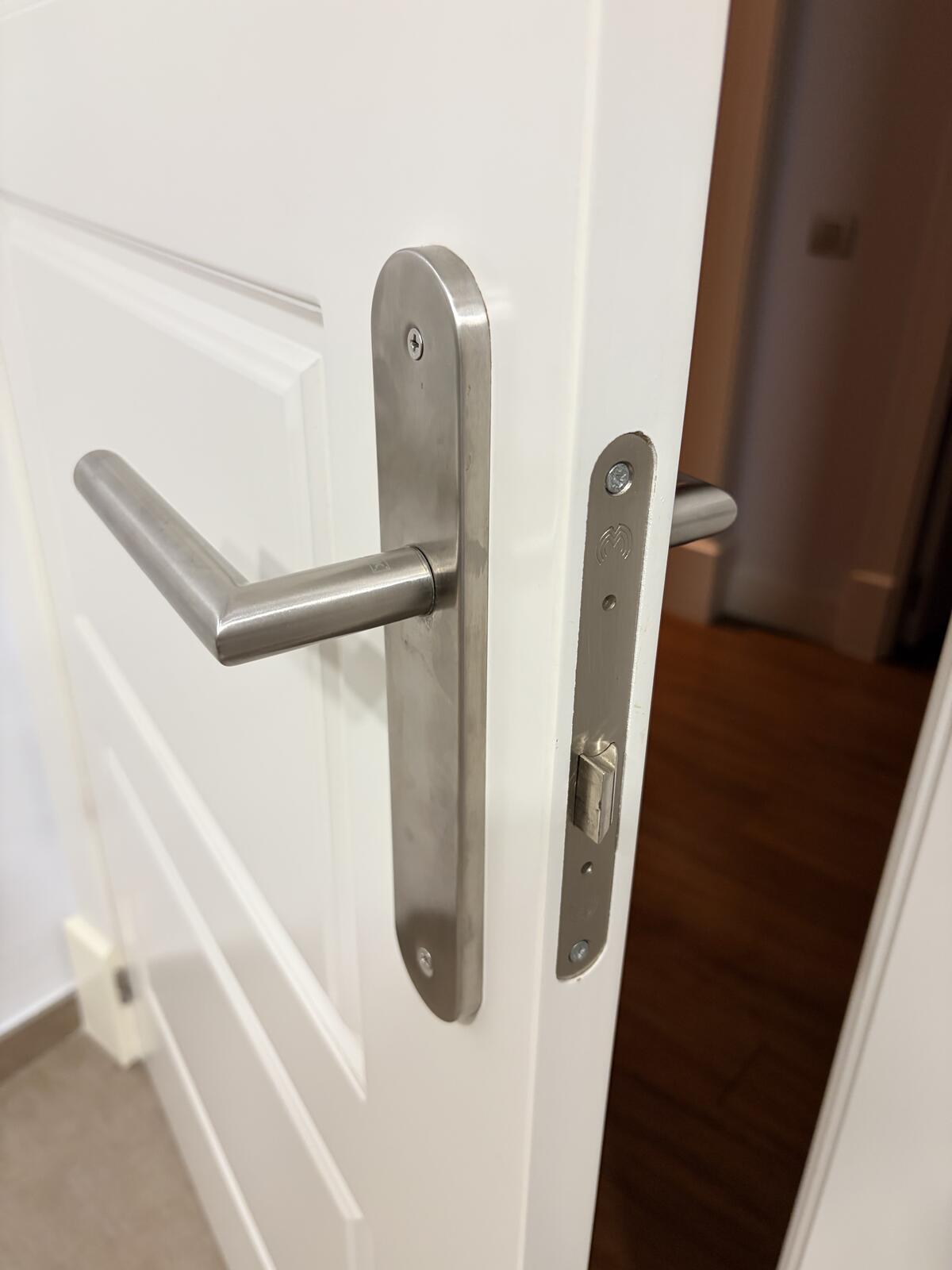
Most modern lever handles use a concealed set screw, usually on the underside or the narrow edge of the lever base. If you cannot see any screws on the rosette, this is almost certainly your type.
- Look along the neck of the lever (the thin section between the handle and the rosette). You should find a small hole or a tiny hex-head screw. A flashlight helps here.
- Insert the correct Allen key and turn clockwise until snug. Do not over-tighten. You are compressing the set screw against the spindle, not torquing a bolt.
- If the rosette itself is loose, look for a small slot on its edge. Insert a flat-head screwdriver and gently rotate the rosette clockwise to thread it back onto the mounting plate.
- Test the lever. It should return to horizontal (or its designed resting position) without wobbling.
Type 3: Push-through knob with a detent button
Some basic interior knobs have a small recessed button (often called a detent) on the shank of the knob. You press this button to remove the knob, exposing the mounting plate screws underneath.
- Press the detent button with a small flat-head screwdriver or the end of a paperclip, and pull the knob off the spindle.
- Remove the decorative rosette (it usually pops off or unscrews).
- Tighten the mounting plate screws underneath.
- Reassemble in reverse order: rosette first, then press the knob back until the detent clicks.
If tightening does not solve the wobble, the spindle itself may be worn, or the screw holes in the door may be stripped. At that point, submit a maintenance request rather than trying to patch it yourself. Filling screw holes with toothpicks or wood filler is a common internet tip, but in a rental you do not own the door, and a maintenance technician can handle it cleanly.
Fixing a stiff or sticky lock (lubrication)
If your key goes in but fights you on the turn, or if the lock cylinder feels gritty and reluctant, the problem is almost always dirt, dust, or dryness inside the cylinder. This is the one repair where the right product matters a lot.
Why graphite, not WD-40
Lock cylinders contain small spring-loaded pins that need to move freely. Liquid lubricants like WD-40, cooking oil, or silicone spray attract dust and eventually create a sticky paste inside the cylinder that makes the problem worse over time. Graphite powder is a dry lubricant that coats the pins without attracting debris. It is the product recommended by locksmiths and lock manufacturers.
I can't tell you how many locks I've opened up only to find a thick, gummy paste inside--the residue of WD-40 that someone sprayed in six months ago, now mixed with dust and acting like glue. Last year I had a tenant whose front door key was nearly impossible to turn. She'd been spraying WD-40 into it every few weeks, thinking she was maintaining it. Each application made things worse. I cleaned out the cylinder, hit it with graphite, and the key turned like butter. She couldn't believe the same lock that nearly broke her key five minutes earlier was now working perfectly. The product matters more than the effort here.
Step-by-step: graphite lubrication
- Buy a graphite lock lubricant. Small squeeze tubes are available at any hardware store, usually for a few dollars. The tube has a narrow tip designed to fit into a keyway.
- Insert the tube tip into the keyway (the slot where your key goes) and give two or three short puffs. You do not need much. A light dusting inside the cylinder is sufficient.
- Insert your key and work it in and out slowly about ten times. Then turn the key back and forth through its full rotation several times. This distributes the graphite across the internal pins.
- Wipe the key and the face of the lock with a cloth. Graphite is a fine black powder and will leave marks on your fingers and clothes if you are not careful.
- Test the lock. The key should turn smoothly with noticeably less resistance. If it does not improve at all, the internal mechanism may have a damaged pin or a more serious issue that warrants a maintenance call.
How often to lubricate
For locks you use daily (front door, bedroom), once every six to twelve months is reasonable. If you live in a dusty climate or near a construction zone, every three to four months may be better. Interior locks that see less traffic may only need attention once a year or when they start feeling stiff.
Other lock lubrication tips
- Do not blow compressed air into the lock before lubricating. It can push debris deeper into the mechanism.
- If someone already sprayed WD-40 in there, the graphite can still help, but it may take a few applications over the next couple of weeks as the old residue works itself out.
- Graphite on the latch bolt: you can also apply a tiny amount to the latch bolt and the opening in the strike plate if the latch sticks when sliding in and out. Wipe excess off the door edge.
Deadbolt alignment issues
A deadbolt that grinds, catches, or refuses to fully extend into the strike plate is a frustrating daily problem. It usually means the door or the frame has shifted slightly, so the bolt no longer lines up with the hole in the strike plate. In rentals, this is especially common in older buildings, after seasonal temperature changes, or in units with settling foundations.
How to identify the misalignment
- Close the door without engaging the deadbolt. Look at the gap between the door edge and the frame on the lock side. Is it even from top to bottom? An uneven gap often means the door has dropped or the frame has shifted.
- Slowly turn the deadbolt and watch where the bolt contacts the strike plate. You may see fresh scrape marks or shiny metal on the plate edge where the bolt is dragging.
- Mark the contact point if you want to document it for maintenance. A small piece of painter's tape on the strike plate at the scrape mark communicates the issue clearly in a photo.
What renters can safely do
- Tighten the hinge screws on the door. A sagging door is often the root cause, and tightening the top hinge screws can lift the door enough to restore alignment. See our squeaky door and sticking latch guide for more on this technique.
- Lubricate the bolt with a small amount of dry silicone spray on the bolt itself and wipe excess. This does not fix alignment, but it can reduce friction enough to make the bolt operational while you wait for a proper repair.
- Avoid forcing it. Slamming the door harder or yanking the deadbolt with extra force can bend the bolt, strip the thumbturn mechanism, or crack the strike plate mounting. If it takes significant force to lock your door, that is a maintenance issue.
What renters should NOT do
- Do not file or grind the strike plate opening to make the hole bigger. This modifies the landlord's property and may weaken the security of the deadbolt engagement.
- Do not reposition the strike plate yourself. Moving a strike plate means new screw holes in the door frame, and in a rental that is not your call to make.
- Do not remove the strike plate and leave it off. Even if the deadbolt works without it, the plate reinforces the frame against forced entry.
Interior vs exterior lock rules for renters
Understanding this distinction saves renters a lot of grief. The rules are different because the stakes are different.
Interior locks (bedroom, bathroom, closet)
- Tightening and lubrication are almost always fine. These are passage or privacy locks without security implications.
- Privacy lock stuck (push-button or twist type on a bathroom door)? Try lubricating the mechanism with graphite. If the push-button won't pop back out, the internal spring may be broken. Submit a request rather than disassembling.
- Replacing interior knobs is a gray area. Some landlords are fine with it if you keep the original hardware and reinstall it at move-out. Others want all hardware changes to go through maintenance. When in doubt, ask in writing before swapping anything.
Exterior locks (front door, back door, patio, garage entry)
- Lubrication is fine. Graphite in the keyway and silicone on the bolt are basic maintenance that preserves the hardware.
- Re-keying is the landlord's job. Many jurisdictions actually require landlords to re-key between tenants. You should never pay a locksmith to re-key a rental lock, and you should never do it yourself without explicit written permission.
- Adding locks (chain locks, secondary deadbolts, smart locks) typically requires landlord approval and, depending on your lease, may be prohibited entirely. Always ask first and get approval in writing.
- Broken exterior lock = urgent maintenance request. If your front door lock fails, does not engage, or can be opened without a key, treat it as a security emergency. Most leases require the landlord to address security hardware promptly.
Common mistakes renters make with door hardware
These come up again and again in maintenance calls. Avoiding them will save you time and protect your deposit.
- Spraying WD-40 into the keyway. This is the most common mistake by far. It feels like it works at first because WD-40 is a solvent and displaces grime temporarily, but it leaves an oily residue that attracts dust. Within weeks the lock feels worse than before. Use graphite.
- Over-tightening handle screws. When a knob is loose, the instinct is to crank the screws down as hard as possible. But door hardware screws thread into soft wood or thin metal backing plates. Over-tighten and you strip the holes or crack the rosette. Snug is enough.
- Trying to re-key or disassemble a lock cylinder. Lock cylinders are precision mechanisms with small pins and springs. Disassembling one without training usually means scattered parts and a lock that can no longer be keyed. This also likely violates your lease.
- Ignoring a gradually worsening deadbolt. If you have to jiggle, lift, or slam the door to get the deadbolt to engage, report it now. The alignment will not fix itself, and the longer you force it, the more damage accumulates on the bolt, the strike plate, and the frame.
- Using cooking oil or petroleum jelly on locks. Like WD-40, these attract dust and gum up over time. They also stain the door finish if they drip.
- Removing screws you cannot identify. If you are not sure what a screw does, leave it alone. Some screws on lock hardware hold the entire assembly to the door. Removing the wrong one can cause the lock set to fall apart.
When to call maintenance
Not everything is a renter fix, and recognizing the boundary quickly protects both you and the property. Call maintenance or submit a priority work order for any of these situations:
- Exterior lock is broken or will not engage. This is a security issue and most leases treat it as urgent. Document the problem with a photo or video and note the date and time in your request.
- Key snaps off inside the lock. Do not try to extract it yourself with pliers or a needle. A locksmith or maintenance tech has extraction tools designed for this. Forcing it can push the broken piece deeper and damage the cylinder.
- Lock cylinder spins freely without engaging the bolt. The internal tailpiece is broken. The lock is non-functional and needs replacement.
- Deadbolt will not extend or retract at all. If the thumbturn or key turns but nothing happens, the internal mechanism has failed. Do not force it.
- Lockout. If you are locked out, contact your landlord or building management first. Many buildings have a lockout protocol. Calling a locksmith yourself may void your lease terms and the cost may not be reimbursable.
- Door frame is cracked or the strike plate area is damaged. This weakens the security of the door and is a structural repair that belongs to the property owner.
- Any situation that makes you feel unsafe. If a lock issue compromises your sense of security, do not wait. Report it in writing immediately and follow up if you do not get a prompt response.
Maintenance request template (copy/paste)
Subject: Door handle / lock issue — [unit number or address]
Hi [Landlord/Maintenance],
The [front door lock / bedroom handle / bathroom knob / deadbolt] in my unit has been [loose / stiff / not engaging / misaligned] since [date]. I tried basic steps (tightened screws / applied graphite lubricant / checked hinge alignment) and the issue persists. [If exterior lock: I want to flag this as a security concern since the lock does not fully engage.]
I have attached [a photo / a short video] showing the problem. I am available [days/times] for a repair visit. Please let me know if you need any additional information.
Thank you.
Preventive maintenance (keep hardware working longer)
A few minutes of attention every few months can prevent most of the problems described in this guide.
- Tighten handle screws every three to four months. Give each knob and lever a gentle test. If there is any play, snug the screws before they loosen further. It takes less than a minute per door.
- Lubricate exterior lock cylinders twice a year. A couple of puffs of graphite in spring and fall keeps the pins moving freely and prevents the gradual buildup that leads to stiff keys.
- Wipe strike plates and latch bolts when you clean door surfaces. Dust and grime on the latch face increases friction.
- Do not slam doors. Impact loosens every piece of hardware over time: screws back out, set screws shift, and alignment drifts. Closing doors gently is the single best preventive measure.
- Report deadbolt grinding early. A small misalignment only gets worse as the bolt wears a groove in the wrong spot. Catching it early means a simple adjustment instead of a full replacement later.
- Keep keys clean. A key that has been rolling around on a dusty workbench carries grit directly into your lock cylinder. Wipe your keys occasionally.
A note on smart locks and aftermarket hardware
Smart locks (keypad, Bluetooth, Wi-Fi-enabled) are increasingly popular, and you may be tempted to install one for convenience. In a rental, the rules are clear: do not install or swap any exterior lock hardware without written landlord approval. Even if the smart lock is designed to replace a standard deadbolt with no permanent modification, your lease almost certainly covers lock changes. Some landlords are open to it, especially if you keep the original hardware and agree to restore it at move-out, but always get that agreement in writing before you buy anything.
If your rental already has a smart lock installed by the landlord, treat it like any other lock. Lubricate the physical keyway if it has one, replace batteries when the low-battery indicator appears, and report malfunctions through the normal maintenance process.
Photo and video checklist (for faster maintenance response)
A clear maintenance request gets resolved faster. When you submit a ticket for a door hardware issue, include as much of the following as you can:
- Photo of the hardware (both sides of the door if relevant). This helps maintenance identify the brand and model before they arrive.
- Short video (10-15 seconds) showing the problem in action: the wobble, the stiff key turn, the deadbolt grinding. Audio is useful for grinding or clicking sounds.
- Close-up of the strike plate if there are visible scrape marks from a misaligned bolt.
- Photo of any gap irregularity between the door edge and the frame if you suspect the door is sagging.
- Written note about when it started, whether it is getting worse, and what you have already tried.
Was this guide helpful? Have a correction or tip? Email [email protected].
Renter for 15+ years. I write practical, landlord-safe fixes I've actually done in my own apartments — no permits, no drama, deposit intact. More about me →